Give the Gift of More: The Hardest Person to Tell the Truth To Is Yourself | Day 4

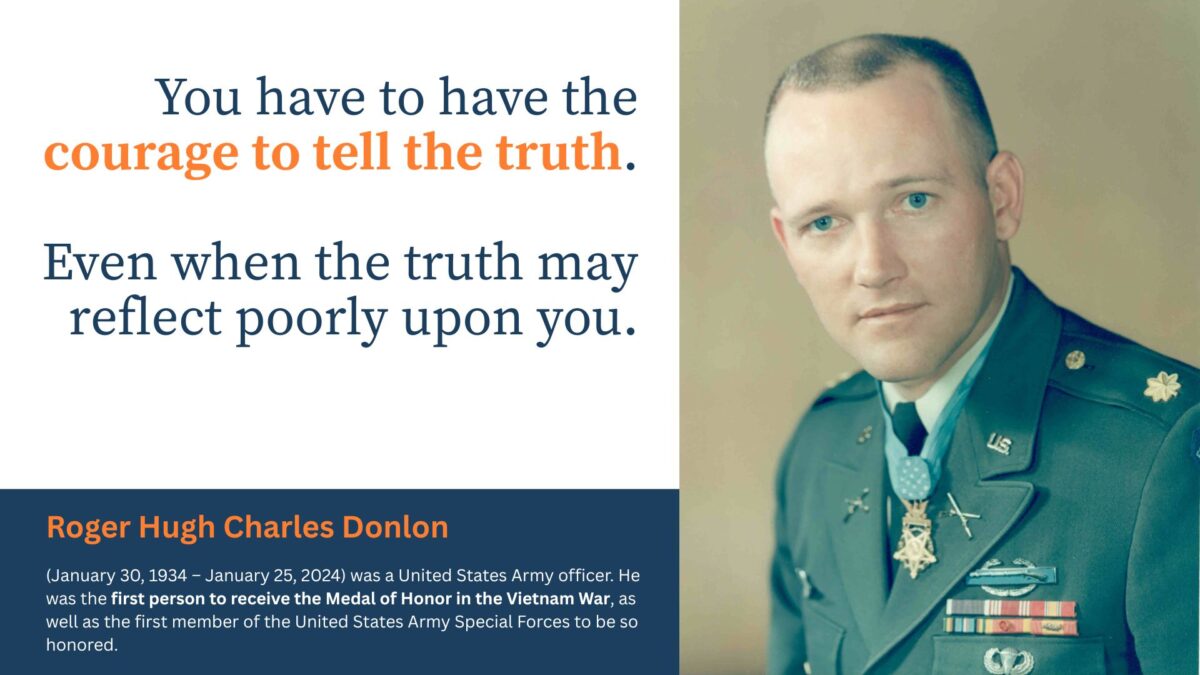
Courage is often misunderstood.
We imagine it as dramatic—decisive action, heroic moments, battlefield bravery. But more often than not, courage shows up in places no one sees. It shows up in the moments when the only person watching… is you.
Today, on Day 4 of the Give the Gift of More campaign, I want to share two stories that reveal the real nature of courage. One comes from a battlefield. The other from my own leadership journey. Both point to a truth that sits at the heart of The More Effect:
The hardest person to tell the truth to is yourself.
A Medal of Honor Story That Redefined Courage
During my podcast conversation today, Colonel (Ret.) Perry Rearick shared a story from his time in Special Forces—an encounter with Roger Donlon, the first Medal of Honor recipient of the Vietnam War.
Donlon survived a five-hour attack on his firebase.
He was wounded multiple times.
He fought through overwhelming odds.
And yet, when he was asked to speak about courage, he didn’t talk about the battle.
He didn’t talk about violence, sacrifice, or heroism.
He talked about telling the truth.
In the Army, every unit files a monthly status report. For years, leaders were pressured to exaggerate readiness—to make the numbers look better on paper than they were in reality. Donlon’s message was simple:
“You have to have the courage to not do that. You have to tell the truth. You’ll be tested.”
This is moral courage.
Not dramatic.
Not visible.
But deeply consequential.
And it set the foundation for what came next.
The Quiet Moments That Shape Us
After Perry shared Donlon’s story, our conversation turned to something more personal: the courage required for self-examination.
This is where the spotlight moves from extraordinary moments… to everyday leadership.
One of the foundational quotes of my life—and of The More Effect—is from Socrates:
“The unexamined life is not worth living.”
It’s been nearly 2,500 years since he said it.
Yet somehow, it feels more relevant than ever.
As leaders, every conversation, every decision, every moment of influence leaves a trace. We like to believe we’re self-aware—but the truth is, many of our behaviors operate on autopilot.
Early in my career, I learned this the hard way.
I would use humor to point things out—subtle jokes that I assumed were harmless. I believed the people I worked with were strong enough to take it. I believed it was part of my leadership style. I believed it was fine.
I was wrong.
Someone finally told my supervisor that my joking was hurtful.
Not playful.
Not constructive.
Hurtful.
Hearing that shook me.
The blind spot wasn’t small. It was enormous. And I had never seen it—not because it wasn’t there, but because I had never looked carefully enough.
That moment changed me.
I learned that words carry weight, especially when people look to you as a leader.
I learned that intentions do not erase impact.
And I learned that courage isn’t always bold—it’s often quiet, humbling, and deeply personal.
Sometimes the bravest thing you can do is look yourself in the mirror and tell yourself the truth.
The Courage to Look Within
One of the central ideas in The More Effect is that becoming more always begins within. You can’t grow without honestly seeing your own patterns, habits, and blind spots. You can’t lead others well unless you are willing to lead yourself first.
That’s why self-examination is such a powerful form of courage.
Not mastery of others.
Not mastery of systems.
But the ongoing practice of mastering your own awareness.
Self-examination is the starting point of all growth.
Without it, courage goes nowhere. Leadership goes nowhere. Possibility goes nowhere.
The spark of becoming more begins the moment you ask:
“What would the courageous version of me have done?”
That question has guided me through more decisions than I can count.
It forces honesty.
It removes ego.
It pulls you toward a better version of yourself — one choice at a time.
You can find the book on Amazon and learn more here: www.TheMoreEffectBook.com
Subscribe to the Business @ the Speed of AI Podcast
Stay ahead of the AI-driven future with practical insights for modern leaders.



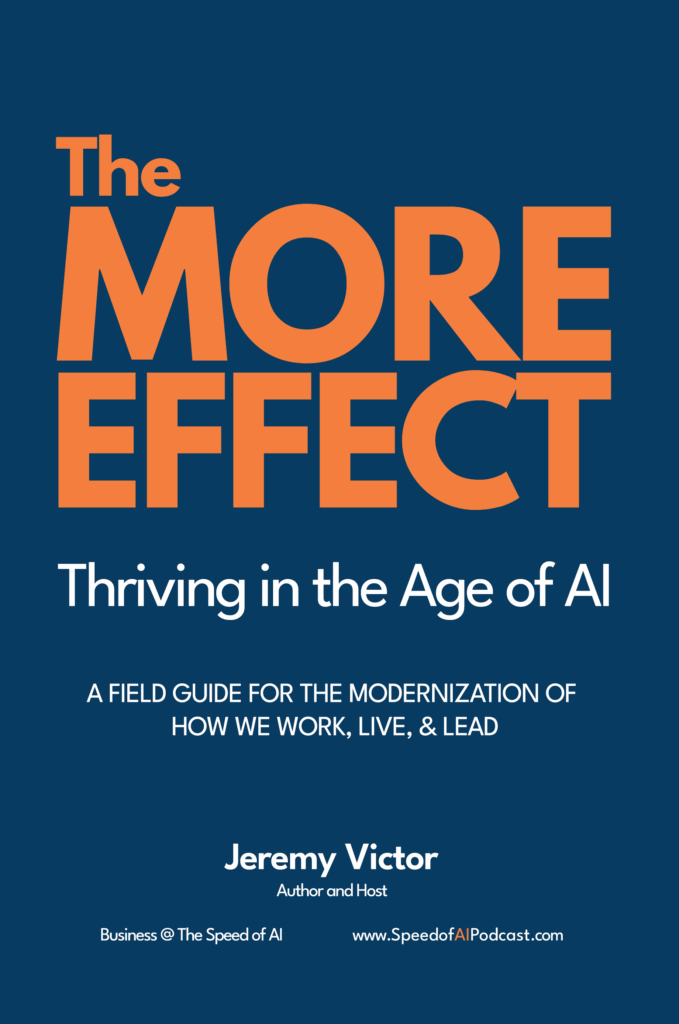
Discover The MORE Effect
A field guide for leading and living with courage, hope, and optimism in the AI-first, always-on world.
About Jeremy
Jeremy Victor is humble, hard working and the author of The MORE Effect. It is the culmination of his life’s work. With one decade as a kid, and three decades in Corporate America, capable of writing, designing, building, and caring, he’s driven to help others become more. No matter the role, no matter the moment, service to others, achieving desired outcomes, and being a good person matter most to him.
He’s the voice behind the Business at the Speed of AI podcast and newsletter, where he explores the intersection of leadership, modernization, and the AI-first always-on economy. His work is guided by a simple belief: that operational excellence and human connection aren’t trade-offs—they’re the future.
His mission: help people—and the systems they work in—Become More.
Join Jeremy online: Website – www.jeremyvictor.com | Newsletter: Business @ the Speed of AI Facebook | Instagram | TikTok OneMORE Minute |
