The Enemy of Presence Is Short-Form Video

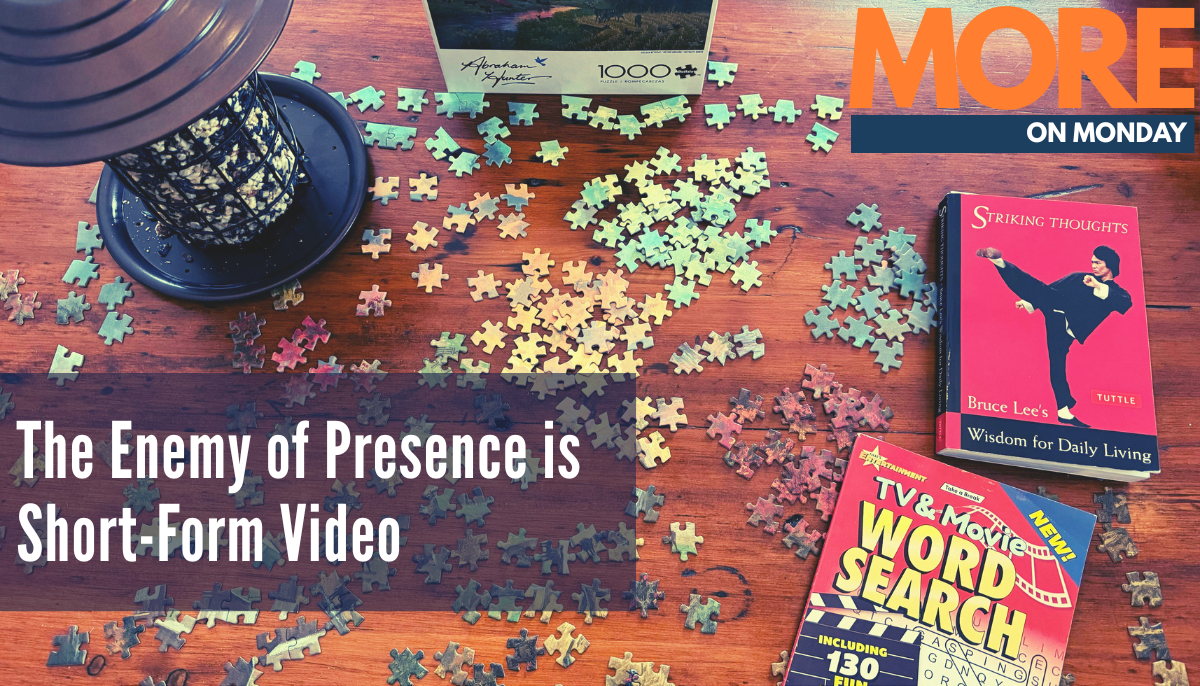
Why Feeds Steal Attention—and How to Reclaim What’s Human
More on Monday — First Monday of 2026
Welcome to the first More on Monday of 2026.
For those who’ve been here before, Mondays are our reset. Not a rush. Not a hack. A moment to decide how we’re going to show up — for our work, our families, and ourselves — before the week starts pulling at us.
For those who are new, welcome. More on Monday began as a weekly reflection series. Over time, those reflections became the foundation of my first book, The MORE Effect. What started as short essays on presence, opportunity, relationships, and execution turned into a leadership field guide for an AI-first, always-on world.
What’s coming next matters too.
Book 2 of The MORE Effect series, Quotes of MORE, is on the way — distilled reminders you can carry with you. And the third book, Two MORE, will explore what happens when intention meets repetition — when small, human choices compound into identity over time, and how to manage caution and risk in the Age of AI.
This article is the kickoff for 2026. It sets the tone.
And there’s no better place to begin than here.
The Resolution We’re All Making
As the calendar turned, a lot of people made the same quiet New Year’s resolution:
I want my attention back. Reduce my screen time.
Some deleted apps.
Some set screen limits.
Some tried a surprisingly effective trick: turning their phone to grayscale, a recommendation from Michael Easter in 2023, to make endless scrolling less seductive.
That trick works — not because grayscale is the solution, but because it reveals the problem.
This isn’t a willpower issue.
It’s a design issue.
Feeds Are Optimized for Engagement,
Not Human Flourishing
This is the line to carry into 2026:
Feeds are optimized for engagement, not human flourishing.
Short-form video feeds are not neutral.
They are engineered systems.
Their goal is not calm.
Not clarity.
Not depth.
Their goal is to hold your attention:
- More watch time
- More swipes
- More return visits
And they are extraordinarily good at it.
What many of us have felt intuitively is now supported by serious psychological research.
In the September 2025 publication of the Psychological Bulletin a large-scale analysis of studies published in 2025 show that passive, feed-driven short-form video use is associated with:
- Increased stress and anxiety
- Reduced attentional control and focus
- Greater emotional volatility
- Cognitive fatigue
The most important distinction wasn’t about screens in general.
It was about Short-form video feeds. I discussed this on Day 15 of the Give The Gift of MORE campaign and it’s the reason why Principle 5 of The MORE Effect exists:
Don’t Let the Device Control You.
It’s not the device itself — it’s the feed that’s doing the controlling.
The device just happens to be what we’re staring at.
Why Presence Is the First Casualty
Presence doesn’t disappear all at once.
It erodes quietly.
You’re in the room, but not fully there.
You’re listening, but only halfway.
You sit down to rest, but never feel restored.
Short-form feeds train the brain for:
- Constant novelty
- Rapid context switching
- Emotional stimulation without resolution
Over time:
- Stillness feels uncomfortable
- Depth feels heavy
- Silence feels unproductive
And presence — the ability to fully inhabit a moment — becomes rare.
That matters more than we think.
Presence Is Not a Soft Skill
In an AI-first world, machines will outpace us on speed, optimization, and pattern recognition.
What they cannot replace is:
- Presence
- Emotional regulation
- Deep listening
- Human connection
Leadership depends on these.
Relationships depend on these.
A meaningful life depends on these.
When presence degrades, everything downstream does too.
People don’t burn out because they work too much.
They burn out because their attention is constantly fragmented.
This Is Not Anti-Technology
Let me be clear.
This is not a call to abandon devices or retreat into the past.
Technology is a tool.
But tools should serve us — not condition us.
Phone use is fine.
Phone addiction is not.
Turning your phone to grayscale can help because it introduces friction. It breaks the reflex. It reminds you that you’re being pulled.
But grayscale isn’t the solution.
Agency is.
A Better Way to Begin 2026
So here’s the invitation for this first Monday of the year.
Don’t aim for perfect screen habits.
Aim for intentional presence.
Start small. Protect a few feed-free moments each day:
- Meals
- Conversations
- Meetings
- Thinking time
Then replace the scroll with something physical. Tangible. Real.
Pick up something that asks for patience instead of novelty:
- A puzzle on the table
- A crossword from an actual newspaper
- A jumble you work through slowly
- Birding. Walking. Looking up.
- A physical book – one you can hold, mark, return to … a field guide
Eyes up. Phones down.
Not because technology is bad —
but because presence is valuable.
Principle 1 of The MORE Effect: Time is all you have. Valuable things deserve protection.
This year, More on Monday will continue to explore how we reclaim what’s human in a world that increasingly competes for our attention.
Not by doing less.
But by becoming more.
Welcome to 2026.
Give The Moment More.
(Principle 3 of The MORE Effect)
Discover The MORE Effect
A field guide for leading and living with courage, hope, and optimism in the AI-first, always-on world.
About Jeremy
Jeremy Victor is a transformational COO, author, and podcast host focused on helping companies scale with empathy, efficiency, and AI. A human-first operator with 30 years of experience leading through every major tech inflection point—from the birth of the internet to today’s AI revolution—Jeremy turns complexity into growth and chaos into calm.
He’s the voice behind the Business at the Speed of AI podcast and newsletter, where he explores the intersection of leadership, modernization, and the always-on economy. His work is guided by a simple belief: that operational excellence and human connection aren’t trade-offs—they’re the future.
His mission: help people—and the systems they work in—Become More.
Join Jeremy online:
Substack Business at the Speed of AI, LinkedIn, Instagram, and TikTok, OneMORE Minute.
